Sketchnote
One-page summary
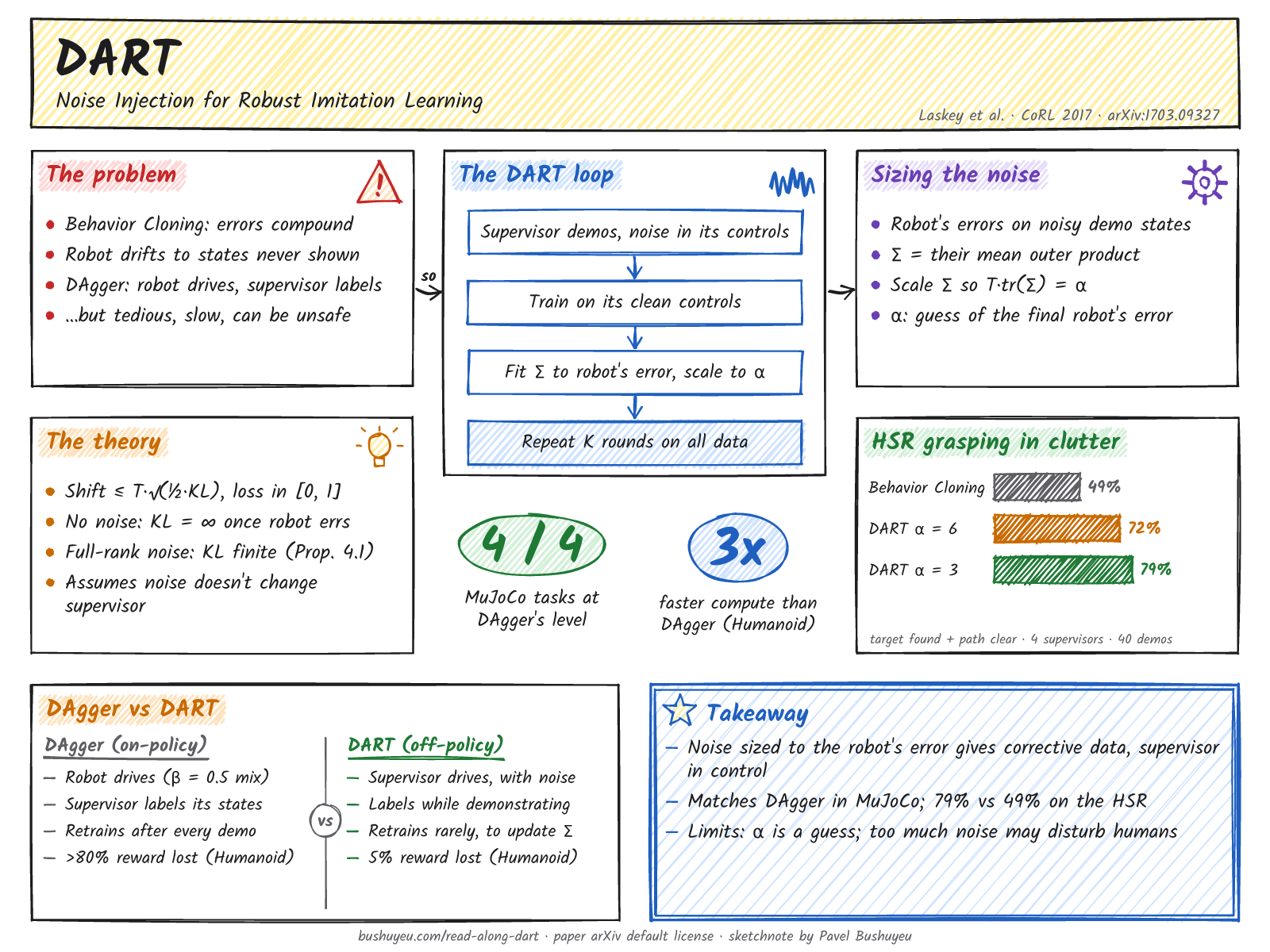
DART: Noise Injection for Robust Imitation Learning. Laskey, Lee, Fox, Dragan and Goldberg, CoRL 2017.
Summary
DART (Disturbances for Augmenting Robot Trajectories) is Behavior Cloning with noise: while the supervisor demonstrates, Gaussian noise is added to the controls it executes, so it has to recover from small errors, and the robot is trained on the supervisor's noise-free controls at the states it reached.
The noise covariance is fit to the current robot policy's error and scaled to a guess of its final error, so the data shows the kind of errors the robot will make while the supervisor stays in control (off-policy).
In four MuJoCo tasks DART matches DAgger and is 3x faster in computation on Humanoid, and on a Toyota HSR task of finding a target in clutter and clearing a path to it, it reaches 79% success against Behavior Cloning's 49%.
One-page summary
In class
Keep these in mind while the presenter talks. Tick them on page 2 of the PDF as they come up.
FAQ
No. The noise changes which states the supervisor visits, not the targets. Eq. 2 trains on J(θ, θ* | ξ), which compares the robot's control with the supervisor's control π_θ*(x_t) at each visited state, not with the noisy control that was executed. The paper states this through the equation, not in words. (Sec. 3, Sec. 4, Eq. 2)
The supervisor, with noise added to its controls. The robot's own policy is never executed during collection; it is used only to estimate how much noise to inject. That is why DART is off-policy, while DAgger is on-policy: DAgger rolls out the robot's policy and asks for labels at the states the robot visits. In the experiments, DAgger mixed the robot's policy with the supervisor's (β = 0.5). (Sec. 1, Sec. 4, Fig. 1, Appendix 4.3)
From the learner's current error. After each round it trains a policy, compares that policy's controls with the supervisor's on states from the noisy supervisor's demonstrations, and averages the outer products of the differences, without subtracting their mean, to fit zero-mean noise (the closed form of Eq. 3). Eq. 4 then rescales this covariance so that the squared deviation the noise causes over a demonstration, T·tr(Σ), equals α. In MuJoCo the covariance was estimated on held-out demonstrations from earlier iterations. (Sec. 4.1, Eq. 3–4, Algorithm 1, Appendix 4.3)
α is a guess of the final robot's error, the target for T·tr(Σ). In MuJoCo the authors set α = T·tr(Σ̂_k), which adds no prior knowledge: the noise is just the learner's current error. On the HSR, α = 3 means three times the error measured after the first 10 demonstrations, T·tr(Σ̂_1), because with few demonstrations in image space the authors expected the robot's error on its own states to be much larger. The text prints both HSR choices as 3T·tr(Σ̂_1); the shorthand α = 6 shows the second is meant to be 6T·tr(Σ̂_1). (Sec. 4.1, Sec. 5.2, Appendix 4.3)
It bounds the covariate shift: the gap between the robot's loss on the noisy supervisor's trajectories and its loss on its own trajectories is at most T·√(½·KL), where KL is the divergence between the robot's and the noisy supervisor's trajectory distributions. It needs a surrogate loss between 0 and 1, for example discrete actions or bounded, normalized controls. The proof uses total variation and Pinsker's inequality. Minimizing this KL over the noise reduces to making the robot's controls likely under the noisy supervisor, which DART approximates round by round (Eq. 3). (Sec. 4, Lemma 4.1, Appendix 8.1)
No. It shows only that, when the robot makes any error, the KL divergence in the bound is smaller with Gaussian noise than without it. The proof is short: with a deterministic supervisor and no noise the divergence is infinite, and Gaussian noise that gives every control a non-zero probability (a full-rank Σ) makes it finite. The argument needs only that support, so it says nothing about which noise level is best, and it assumes the noise does not change how the supervisor behaves. (Sec. 4.2, Proposition 4.1, Appendix 8.1)
When the robot can represent the supervisor perfectly and has enough data. Then its error is zero, there is no error to simulate, and the condition of Proposition 4.1 (error greater than 0) fails. The paper argues that in practice there is rarely enough data to represent the supervisor perfectly, and notes a similar result for when DAgger beats Behavior Cloning (Laskey et al. 2016). (Sec. 4.2)
No. DART matches DAgger in all four tasks, but the paper says Behavior Cloning and DAgger-B fall below that level in Walker and Humanoid, and names no gap in Hopper or Half-Cheetah. The supervisor is a TRPO policy (two hidden layers of 64 units), and each demonstration is cut to 50 sampled state–control pairs to make imitation harder. (Sec. 5.1, Fig. 2)
From Humanoid, the largest task (376-dimensional state, 17-dimensional control). DART needed 3x less computation time than DAgger, because there DART first collects 50 supervisor demonstrations and then retrains every 25 iterations, while DAgger retrains after every demonstration. While collecting data, DART's noisy supervisor earned 5% less reward than the clean supervisor, but the policies DAgger executed earned over 80% less. The abstract's "up to 3x" refers to this task. (Abstract, Sec. 5.1, Fig. 2, Appendix 4.3)
They are HSR task-success rates: DART with α = 3 reached 79% and Behavior Cloning 49%, where success means the robot found the goal object and cleared a path to it (then a human, blind to which policy ran, triggered an open-loop grasp). The abstract's 62% is a relative increase, not 62 points: the rounded rates give about 61% (1.6 times), or 30 points, and the paper does not show its calculation. Each policy was tested 20 times from sampled initial states, and the paper reports the results as averages for its four supervisors; 79, 49 and 72 are not multiples of 5, so they are not one set of 20 trials. (Abstract, Sec. 1, Sec. 5.2, Fig. 3, Appendix 4.5)
The paper does not test why. The authors suggest this much noise may have been too high for the human supervisors. If it changed how they demonstrated, Proposition 4.1's assumption that the noise does not change the supervisor would fail, but the experiment does not show that. Only two values of α were tried: each supervisor gave 10 noise-free demonstrations, then 30 more with each method, and each final policy was trained on 40. (Sec. 4.2, Sec. 5.2)
In MuJoCo, the size seems to matter most. Random covariance matrices (Wishart samples) scaled to a well-chosen trace, 0.5, matched DART's losses, while traces of 0.005 and 5.0 (10.0 for Humanoid) could give much higher losses. Isotropic noise with Σ = I did poorly and led to unsafe policies. The paper's point is that the right size is not known before training, and DART estimates it from the learner. (Sec. 5.1, Appendix 4.3, Appendix 4.4, Fig. 5)
Glossary
Links
How this page was made. The video is an AI narration (Breeze TTS 2) of the full paper with the text on screen. The summary, questions and sketchnote were drafted with an AI assistant from the paper's text and checked against it; the references in brackets point to the paper. Paper license: arXiv default license. The sketchnote is an original drawing, not a copy of the paper's figures.