-
BenchmarkA long-horizon benchmark built on NVIDIA Isaac Lab. In one episode a Unitree G1 positions a step ladder under a fixture, climbs it, exchanges a spent bulb for a fresh one and disposes of the spent one. Twelve subtask environments scored on difficulty-weighted gates, standard and privileged observation modes, and reference baselines spanning RSL-RL PPO, zero-shot GR00T N1.7 and whole-body controllers.
-
AnalysisWhat the 100-task BEHAVIOR Challenge 2026 benchmark is made of, read from the evaluator’s code and all 20,000 recorded demonstrations.
-
ReproductionPriced the report’s five claims against available compute, characterised the released rejection-sampling dataset without a GPU, and evaluated the released π0.5-based checkpoint on two machines. Fixes to the evaluation stack are in the fork.
-
ExperimentLinear probes on patch tokens with exact labels replayed from the simulator, a weights-pinned token-budget sweep with SigLIP 2 NaFlex, and an encoder swap against SigLIP 1 and DINOv2. Preliminary results sit near chance on spatial relations.
-
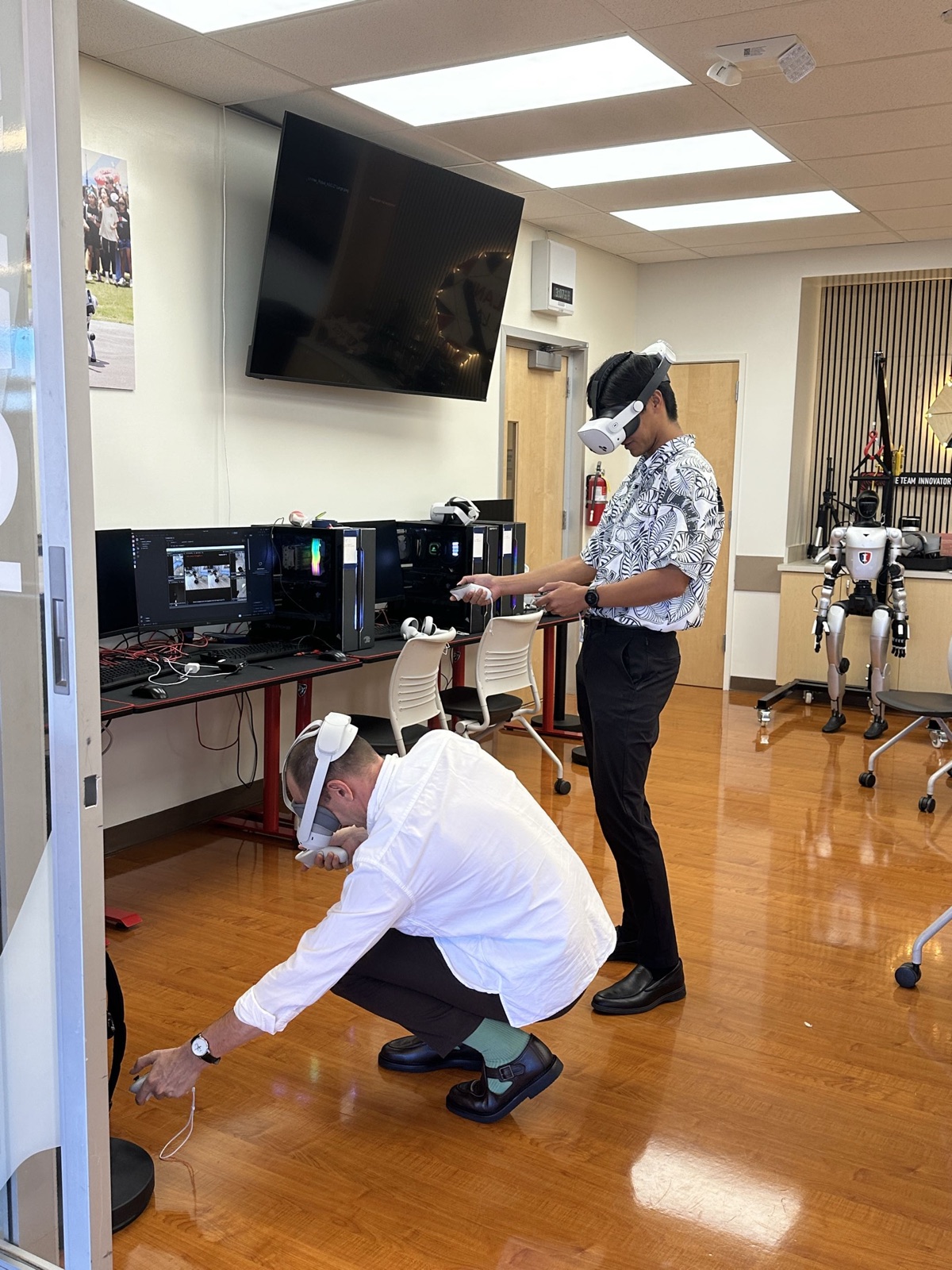
WorkshopA pipeline that turns an ordinary video into motion on a Unitree G1 humanoid: PromptHMR estimates 3D pose, GMR retargets the joints, and GR00T whole-body control drives simulation or hardware. The codebase for the ʻIolani workshop on applied ML and humanoid robots.
-
ExperimentsThree experiments on adding 6-axis force-torque sensing to SmolVLA, a 0.45B vision-language-action model, for contact-rich manipulation tasks. SmolVLA takes vision and joint positions as input but has no sense of touch; the experiments test whether force augmentation works at that scale.
-
ExperimentPhysical Intelligence’s FAST+ action tokenizer against a custom-fit FAST tokenizer and naive binning on 1,647 real Berkeley cable-routing episodes, across 72 configurations. FAST+ keeps a median 81% of the custom tokenizer’s compression.